
Hydrojetting or Auger? Choosing the Right Method in Mauá SP
When a technician looks into your drain and says, “this one needs hydrojetting,” it’s natural to wonder whether a simpler tool like a mechanical auger would do the job for less. The answer depends entirely on what is blocking the pipe and what condition the pipe is in. In Mauá and across the ABC region, clogs range from soft soap scum to hard scale and roots, and each responds differently to these two methods. If you are searching for a reliable desentupidora Guarulhos SP, understanding the difference helps you ask the right questions before anyone starts work.
What a Mechanical Auger Actually Does Inside the Pipe
A mechanical auger, often called a drain snake, is a flexible steel cable with a cutting head at the tip. It is fed into the pipe and rotated to break through or pull back a blockage. The tool is effective because it applies concentrated force at a single point, which makes it ideal for soft or fibrous obstructions that sit close to the access point.
Where an auger works best
Augers excel at clearing isolated clogs in branch lines, such as a bathroom sink or a floor drain that has accumulated hair, soap residue or paper. They are also the go-to tool for a toilet that is plugged by an object or an excess of paper, because the cable can grab and retrieve the material without flooding the bowl. In these situations, a desentupidora Guarulhos technician can often solve the problem in minutes with minimal disruption.
Limitations you should know
An auger does not clean the pipe wall. It punches a hole through the blockage, which restores flow but leaves residue behind. Grease, scale and biofilm can stay attached and cause another clog weeks later. On older pipes, the rotating cable can also scratch or crack fragile materials if the operator is not careful. For a recurring problem, that partial cleaning is often the reason the drain backs up again.
How Hydrojetting Cleans the Whole Pipe
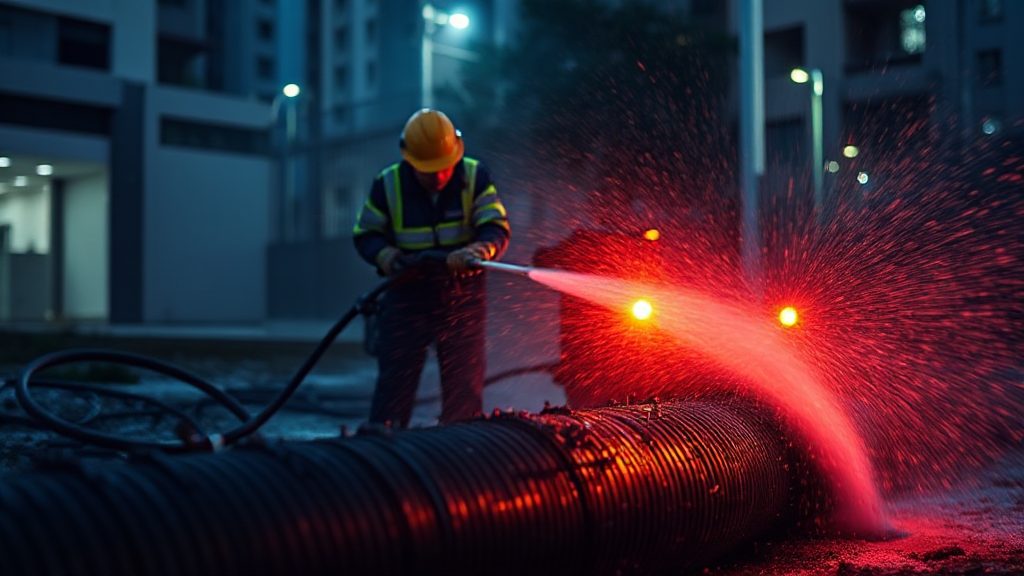
Hydrojetting uses high-pressure water, typically between 1,500 and 4,000 psi, delivered through a specialized nozzle. The nozzle is pulled back through the line while jets of water scour the interior in all directions. Instead of just piercing the clog, this method restores the pipe to something close to its original diameter by removing grease, sand, scale and even light roots.
When hydrojetting is the right call
Hydrojetting is the better choice for main sewer lines, restaurant grease lines and any drain that has clogged repeatedly. It is also effective after an auger has opened a path but the flow remains slow, because the jetting removes what the cable left behind. If you have a desentupidora em Guarulhos SP inspect the line with a camera first, you can confirm whether the pipe can handle the pressure and whether roots or collapsed sections are present.
Risks and preparation
Hydrojetting is not suitable for every pipe. Very old clay or cast-iron lines with existing cracks can be further damaged by high pressure, and a pipe that is already collapsed should not be jetted at all. A professional will usually run a camera inspection and may start at a lower pressure to test the line. Proper containment is also important, since the water exits with debris and must be directed to a safe drain.
Head-to-Head: Auger vs. Hydrojetting on Key Criteria
The table below summarizes how the two methods compare on the factors that matter most when you are deciding what to authorize.
| Criterion | Mechanical auger | Hydrojetting |
|---|---|---|
| Best for | Soft, localized clogs; toilets; branch lines | Grease, scale, roots, main lines, recurring clogs |
| Cleaning effect | Opens a hole; leaves residue on pipe walls | Scours the full interior; restores flow capacity |
| Pipe condition needed | Works in most pipes, but can scratch fragile ones | Requires sound pipe; camera check recommended |
| Typical time | Fast for simple clogs | Longer setup, but thorough |
| Recurrence risk | Higher if residue remains | Lower when the full line is cleaned |
| Cost profile | Lower for a single simple clog | Higher upfront, often better value long term |
The cost difference is real, but it should be weighed against how often the drain has clogged. A single auger visit that fixes a hair clog is economical. Three auger visits in a year usually cost more than one hydrojetting service that solves the underlying buildup. Ask the technician to explain what they found and why they recommend one method over the other.
Which Method for Which Clog?
For a toilet, sink or shower drain with a one-time blockage, an auger is usually enough and is the least invasive option. For a kitchen line that keeps slowing down, a main sewer line with repeated backups, or any drain where grease and scale are likely, hydrojetting is the more durable fix. If the pipe is old, cracked or you do not know its condition, insist on a camera inspection before anyone jets it.
The honest answer to “do I really need hydrojetting?” is sometimes no. A good technician will tell you when a snake will do and when the line needs a full clean. In Mauá and nearby cities, where many homes share older clay and cast-iron laterals, that distinction protects both your plumbing and your budget. Choose the method that matches the clog, not the one that is easiest to sell.